Overview
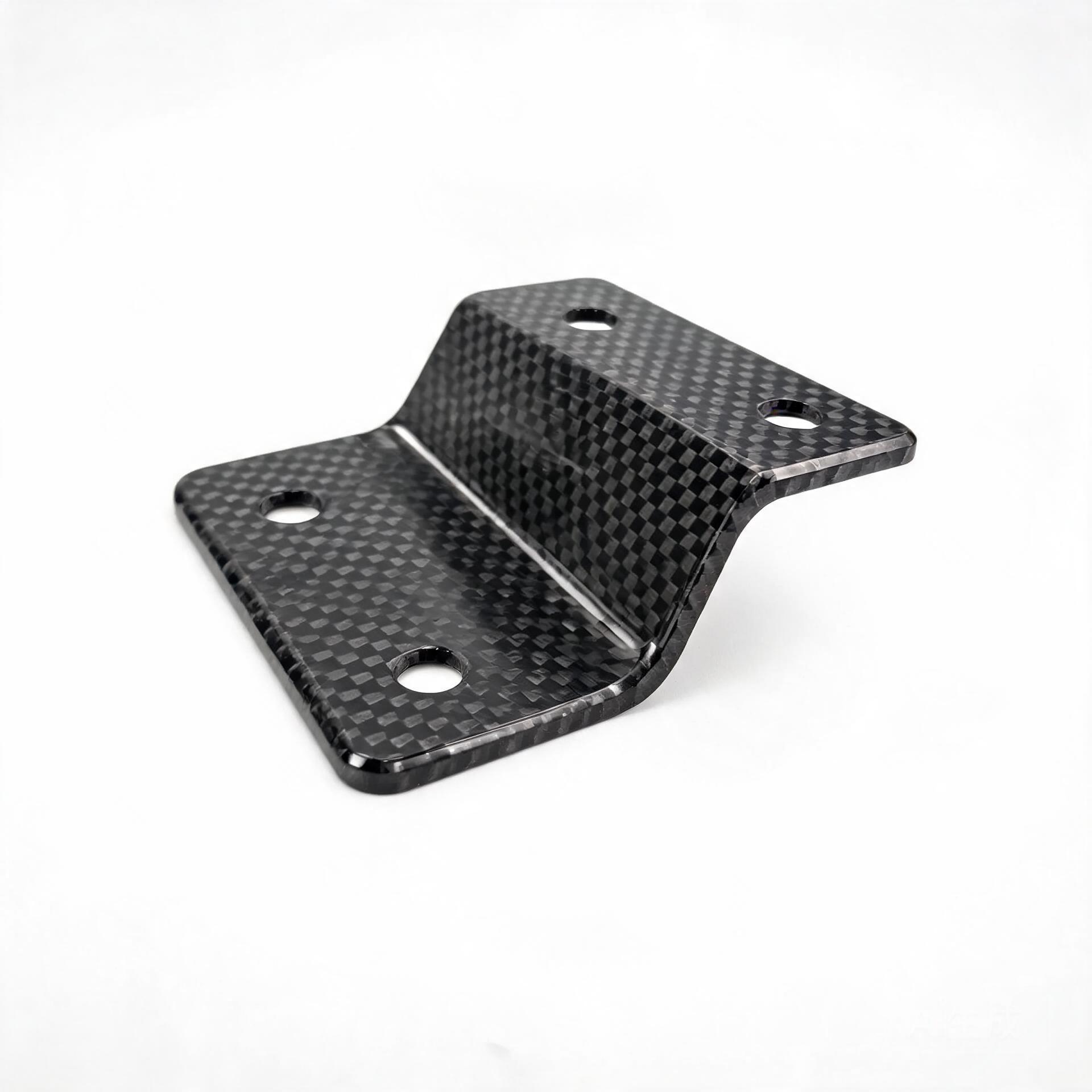
Carbon fiber brackets are high-performance structural components manufactured from carbon fiber reinforced polymer (CFRP) composites, designed to provide exceptional strength and stiffness at a fraction of the weight of metal alternatives. These advanced composite brackets are increasingly replacing aluminum and steel brackets in aerospace, automotive, robotics, and medical applications where weight reduction, high specific strength, and corrosion resistance are critical performance requirements. OrroMFG produces precision carbon fiber brackets using advanced composite manufacturing techniques including autoclave curing, compression molding, and 5-axis CNC machining, delivering lightweight structural solutions with superior mechanical properties.
Our carbon fiber bracket product portfolio includes standard L-brackets, U-brackets, gusset brackets, and custom-designed structural brackets engineered to meet specific load and mounting requirements. We manufacture brackets from various composite materials including unidirectional prepreg carbon fiber (for maximum strength in primary load directions), woven carbon fiber fabrics (for balanced properties and aesthetic appeal), and forged carbon (for complex 3D geometries and high-volume production). Carbon fiber brackets offer weight savings of 50-70% compared to steel and 30-50% compared to aluminum while maintaining comparable or superior strength and stiffness. They also offer excellent fatigue resistance, dimensional stability, and corrosion resistance, making them ideal for long-term structural applications in demanding environments. All our carbon fiber brackets are designed using finite element analysis (FEA) to optimize fiber orientation, laminate stack-up, and geometry for maximum performance and minimum weight.
Key Features
- Exceptional Strength-to-Weight Ratio: 5-10 times the specific strength (strength per unit weight) of steel, enabling dramatic weight reduction without sacrificing structural performance.
- High Stiffness and Rigidity: High modulus of elasticity provides excellent dimensional stability and resistance to deflection under load.
- Excellent Fatigue Resistance: Superior fatigue performance compared to metals, maintaining structural integrity over millions of load cycles.
- Corrosion and Chemical Resistance: Immune to rust and corrosion; resistant to most chemicals, fuels, and environmental factors.
- Design Flexibility: Can be molded into complex shapes with tailored fiber orientations to optimize strength where it’s needed most.
- Dimensional Stability: Low coefficient of thermal expansion ensures consistent dimensions across wide temperature ranges.
Material Specifications
| Property | Standard Modulus CFRP (UD) | High Modulus CFRP (UD) | Woven Carbon Fiber | Forged Carbon (SMC) |
|---|---|---|---|---|
| Density (g/cm³) | 1.50 - 1.60 | 1.55 - 1.70 | 1.45 - 1.55 | 1.50 - 1.65 |
| Tensile Strength (MPa, 0°) | 600 - 1000 | 800 - 1200 | 400 - 600 | 300 - 500 |
| Tensile Modulus (GPa, 0°) | 60 - 90 | 100 - 150 | 40 - 60 | 30 - 50 |
| Compressive Strength (MPa) | 400 - 700 | 500 - 800 | 250 - 400 | 200 - 350 |
| Flexural Strength (MPa) | 500 - 800 | 700 - 1000 | 350 - 550 | 250 - 450 |
| Flexural Modulus (GPa) | 50 - 80 | 90 - 130 | 35 - 50 | 25 - 40 |
| Shear Strength (MPa) | 50 - 80 | 40 - 60 | 60 - 90 | 50 - 70 |
| CTE, Fiber Direction (10⁻⁶/°C) | 0.5 - 1.5 | 0.0 - 0.5 | 2 - 5 | 3 - 8 |
| Fatigue Strength (% of UTS) | 60 - 80% | 60 - 75% | 40 - 60% | 35 - 50% |
| Resin System | Epoxy | Epoxy | Epoxy/Vinyl Ester | Epoxy/Vinyl Ester |
| Fiber Volume Fraction (%) | 55 - 65 | 55 - 65 | 45 - 55 | 35 - 45 |
Applications
Aerospace and Aviation
Carbon fiber brackets are extensively used in aircraft and spacecraft structures including interior mounting brackets, equipment racks, sensor mounts, actuation brackets, and secondary structure components. The significant weight reduction directly translates to fuel savings, increased payload capacity, and improved range. Carbon fiber’s excellent fatigue resistance and dimensional stability over temperature extremes make it ideal for aerospace applications. Both commercial aviation and space launch vehicles rely on carbon fiber composite brackets for structural mounting and equipment support.
Automotive and Motorsports
In high-performance automotive and motorsports applications, carbon fiber brackets are used for engine mounts, suspension brackets, body panel mounts, interior trim brackets, and battery mounting systems in electric vehicles. Weight reduction improves acceleration, handling, braking, and energy efficiency. In Formula 1, IndyCar, and other racing series, carbon fiber brackets are standard equipment for virtually all non-load-bearing structural applications. In electric vehicles, carbon fiber battery mounting brackets help offset the weight of battery packs while maintaining structural integrity.
Robotics and Automation
Carbon fiber brackets and structural components are widely used in industrial robots, collaborative robots (cobots), and automation equipment where low inertia and high stiffness are critical for fast, precise motion. Robot arm links, end effector mounts, and structural frames made from carbon fiber enable higher acceleration rates, shorter cycle times, and improved positioning accuracy compared to aluminum or steel. The high specific stiffness of carbon fiber also minimizes vibration and deflection, contributing to improved manufacturing precision.
Medical Equipment
In medical devices and equipment, carbon fiber brackets are used in surgical robots, imaging equipment (CT, MRI, X-ray), patient positioning systems, and prosthetic devices. Carbon fiber’s radiolucency (transparency to X-rays) is particularly valuable for imaging equipment, as it does not interfere with diagnostic imaging. Its high strength, lightweight nature, and biocompatibility also make it suitable for surgical instruments and implantable devices (when properly certified).
Sports and Recreation
Carbon fiber brackets and components are used in high-performance sports equipment including bicycle frames and components, tennis rackets, golf clubs, skiing equipment, and sailing hardware. The combination of high strength, low weight, and stiffness enables superior performance and athlete comfort.
Operating Conditions
- Temperature Range: -50°C to +120°C (-58°F to +248°F) for standard epoxy systems; up to 200°C for high-temperature resin systems
- Load Capacity: Custom designed for specific applications, with load capacities ranging from a few kilograms to several tons depending on size and design
- Fatigue Life: Excellent fatigue resistance, typically 60-80% of ultimate tensile strength at 10⁶ cycles
- Chemical Compatibility: Resistant to most fuels, oils, solvents, alkalis, and dilute acids; resistant to environmental weathering and UV exposure (with proper surface finish)
- Not Recommended For: Strong oxidizing acids, prolonged exposure to temperatures above glass transition temperature of the resin, and through-thickness tensile loading
- Environmental Resistance: Excellent resistance to corrosion, moisture, and most environmental factors when properly sealed and finished
- EMI/RFI Properties: Carbon fiber is electrically conductive and provides electromagnetic shielding; can be designed for specific EMC requirements
Material Comparison
| Material | Specific Strength | Specific Stiffness | Fatigue Resistance | Corrosion Resistance | Cost | Best For |
|---|---|---|---|---|---|---|
| Carbon Fiber (CFRP) | Excellent | Excellent | Excellent | Excellent | Very High | Lightweight, high-performance, fatigue-critical |
| Aluminum 6061-T6 | Good | Good | Fair | Good | Medium | General structural, moderate weight, machinable |
| Stainless Steel 304 | Fair | Good | Good | Very Good | Medium-High | Corrosion-resistant, heavy-duty structural |
| Titanium (Ti-6Al-4V) | Very Good | Good | Excellent | Excellent | Very High | Aerospace, medical, high-performance metal |
| Magnesium | Good | Fair | Fair | Poor | High | Ultra-lightweight, moderate load apps |
| PEEK (30% CF) | Good | Good | Very Good | Excellent | Very High | High-temp polymer, chemical resistance |
Choose carbon fiber brackets when:
- Maximum strength-to-weight ratio is the primary design requirement
- Weight reduction is critical for performance, energy efficiency, or payload
- High stiffness and dimensional stability are needed
- Excellent fatigue resistance is required for cyclic loading applications
- Corrosion resistance is important for harsh environments
- The application involves aerospace, automotive, robotics, or medical equipment
Customization Options
- Material Systems: Standard modulus carbon fiber, intermediate modulus, high modulus; woven fabrics (2x2 twill, plain weave, unidirectional); prepreg, wet layup, resin transfer molding (RTM), forged carbon SMC
- Resin Systems: Standard epoxy (120°C), high-temperature epoxy (180-200°C), vinyl ester, BMI (bismaleimide) for high-temp aerospace
- Bracket Types: L-brackets, U-brackets, angle brackets, gusset brackets, mounting plates, clevis brackets, custom geometries
- Size Range: From miniature brackets (10mm) to large structural brackets (1000mm+); custom sizes available
- Laminate Design: Custom fiber orientation and ply stack-up optimized via FEA for specific load requirements
- Core Materials: Honeycomb core (aluminum, Nomex), foam core (PMI, PVC) for sandwich panel construction
- Surface Finishes: Matte, gloss, satin weave, clear coat, painted, textured, and cosmetic surface options
- Inserts and Fasteners: Stainless steel, titanium, or aluminum threaded inserts; PEM inserts; bonded or molded-in fasteners
- Tolerance Grades: CNC machined to IT6-IT8 dimensional tolerances; precision features to tighter tolerances
- Color Options: Natural carbon (black), painted any RAL color, and custom aesthetic finishes
- Secondary Operations: Drilling, tapping, milling, bonding, assembly, and non-destructive testing (NDT)
Quality Assurance
OrroMFG maintains rigorous quality control throughout carbon fiber bracket manufacturing. Our ISO 9001:2015 certified quality management system ensures consistent product quality from raw material receipt through final inspection and shipment. We source aerospace-grade carbon fiber prepreg and resin systems from globally recognized manufacturers with full material certification and traceability.
Manufacturing processes including layup, curing, and machining are documented and controlled with strict process parameters. Autoclave cure cycles are monitored and recorded to ensure proper consolidation and cure. Quality control begins with incoming material verification including fiber areal weight, resin content, and shelf-life verification. In-process inspection covers ply orientation, layup sequence, debulking quality, and dimensional verification at each manufacturing stage. Final inspection includes comprehensive dimensional verification using coordinate measuring machines (CMM), visual inspection for cosmetic defects, and ultrasonic or X-ray non-destructive testing (NDT) for internal quality verification when required. We also perform mechanical testing including tensile, compression, flexural, and fatigue testing on representative coupons to validate structural performance. For aerospace and critical applications, we provide detailed material certificates, process records, inspection reports, and full traceability documentation. Our commitment to quality ensures that every carbon fiber bracket we produce meets or exceeds customer specifications and delivers reliable, lightweight structural performance in the most demanding applications.